
Most knee pain in Kolkata does not arrive with a single dramatic injury. It builds. The stairs of an old para building start to feel steeper, sitting cross-legged at a family puja becomes a negotiation, and getting up from a low chair needs a hand on the armrest. Then one week the knee flares, swells a little, and even a short walk to the market feels like too much.
A Pain Lab knee course is our clinic programme for that stage. It is a short, focused course of hands-on therapy and electrotherapy, with laser as an option, run by a physiotherapist at our Naktala and Salt Lake clinics. This article explains what happens in a session, what the research says about these treatments, what the course does not do, and why we plan the next step before the course even ends.
Why a knee hurts more during a flare
A painful knee is not only a worn joint. When the knee is irritated, the lining of the joint and the tissues around it become more sensitive, the muscles around the knee tighten to guard it, and the big thigh muscle on the front, the quadriceps, starts to switch off. Less muscle support means more load lands on the joint with every step, which keeps the irritation going. Our article on knee osteoarthritis without rushing into surgery explains the joint, the X-ray words and the weight and metabolic side in detail, so we will not repeat them here.
Pain itself also changes how we move. Many people start to protect the knee by limping, avoiding stairs and sitting for longer, and the knee gets weaker and stiffer as a result. Our piece on hurt versus harm explains why that protective habit can keep pain alive. The aim of a Pain Lab course is to calm the flare enough that you can move again with confidence.
What happens in a Pain Lab knee session
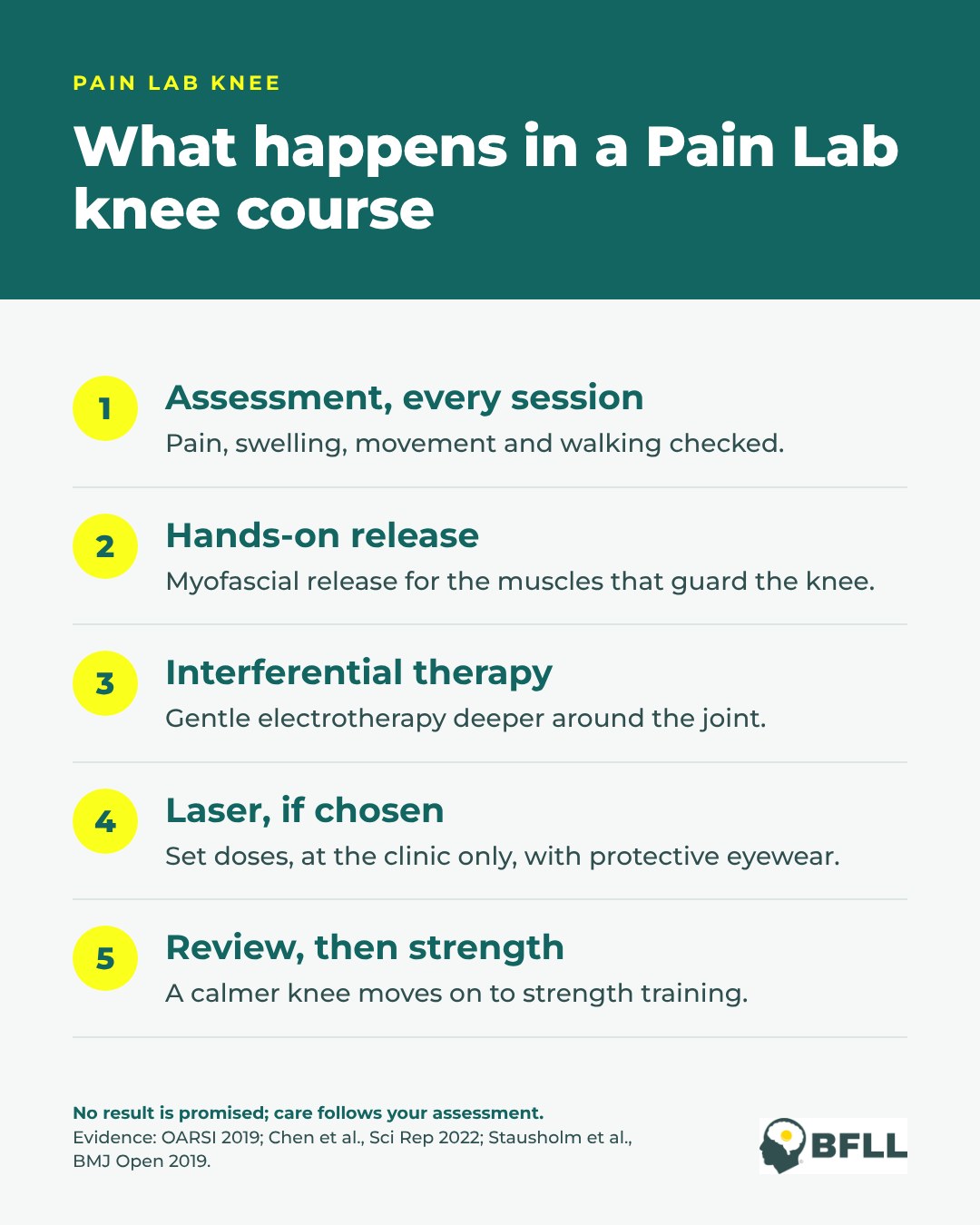
Every Pain Lab knee course starts with an assessment by a physiotherapist and continues with a short check at every session. A typical session brings together three things:
- Assessment every session. Pain level, swelling, range of movement and how you walk, sit down and stand up are checked and recorded, so the plan follows how your knee is actually responding.
- Myofascial release (MFR). Hands-on work by the physiotherapist on the muscles and connective tissue around the knee: the front and back of the thigh, the calf and the tissues beside the kneecap. The aim is to ease guarding and tightness so the knee can bend and straighten more freely.
- Interferential therapy (IFT). A form of electrotherapy in which two medium-frequency currents cross inside the tissue. Most people feel a gentle tingling. It is used to reach deeper around the joint for pain relief.
- Laser, if you choose the laser course. Low-level laser (photobiomodulation) is applied to set points around the joint. It is given only at our clinics, never at home, always with protective eyewear, and it is not used over the thyroid, in pregnancy, over a suspected tumour or with medicines that make the skin sensitive to light. Pain scores are recorded before and after. More detail is on our laser therapy page.
You will also be shown simple ways to move the knee between visits, such as easy range-of-movement work and how to pace stairs and walking while the knee settles. These are not a strength programme. They are about keeping the joint moving.
What the research says, and what it does not
It is worth being clear about the evidence, because it shapes how we use these treatments.
Interferential therapy. A 2022 meta-analysis in Scientific Reports pooled nine randomised trials of interferential current in knee osteoarthritis. It found improvement in pain in the short term and a smaller improvement over the longer term, and better function in the short term only. The authors noted that the trials varied a lot and called for larger, longer studies.
Laser. A 2019 systematic review in BMJ Open pooled 22 placebo-controlled trials with 1,063 patients. At the doses recommended by the World Association for Laser Therapy, low-level laser reduced pain and disability compared with placebo, and the difference was still measurable in trials that followed people for up to 12 weeks after treatment ended. No adverse events were reported in the trials. Dose matters, which is why our laser protocol follows set doses and records every session.
Exercise comes first. International guidelines, including the 2019 Osteoarthritis Research Society International (OARSI) guideline, place education, structured land-based exercise and, where needed, weight management at the core of knee osteoarthritis care. A 2015 Cochrane review of 44 trials found that therapeutic exercise reduced pain and improved physical function, and that some of the benefit lasted two to six months after formal treatment stopped. The NHS describes exercise as one of the most important treatments for osteoarthritis, whatever your age or fitness.
Put together, the honest reading is this. Hands-on therapy, interferential therapy and laser can help settle pain, and that matters, because a calmer knee is a knee you can train. They are not a replacement for building the muscles that protect the joint. Results differ from person to person, and no course can promise a particular outcome.
Why Pain Lab does not include strengthening
This is a deliberate rule at BFLL, not a gap. A Pain Lab course is designed to calm a painful knee. Strengthening, progressive loading and rebuilding everyday function belong to Therapeutic Strength Training (TST), where a strength therapist plans and supervises how much load your knee can take and when to add more.
We keep the two apart because they have different jobs. Pain relief opens a window. Strength is what keeps that window open. Stopping at pain relief often means the same weak quadriceps meet the same stairs, and the flare returns. So towards the end of a Pain Lab course, your physiotherapist reviews how the knee has responded and talks with you about whether, and when, to move into TST.
If you are already an active TST member, you do not need a separate Pain Lab course. Manual therapy and one electrotherapy method are given inside your TST session for the condition you enrolled with, and laser can be added at member rates.
Who a Pain Lab knee course may suit
- Knee osteoarthritis that has flared, with pain on stairs, on standing up or after sitting.
- Pain around or behind the kneecap that limits walking or squatting.
- Stiffness and tightness around the knee after a period of inactivity.
- People who want to settle the pain first before starting strength training.
See a doctor first if the knee is hot, red and swollen with fever, if you cannot put weight on the leg after a fall or twist, if the knee locks or gives way repeatedly, if the calf is swollen and painful, or if the pain is severe and getting worse quickly. After a recent knee operation or injection, start only once your surgeon or treating doctor has cleared you for physiotherapy. If your surgeon has advised a knee replacement, our team will speak with you first to plan the safest next step. Medicines stay with your treating doctor; your physiotherapist will not change them.
Course options and prices
Pain Lab is an OPD programme at both branches. Your first visit includes the Physiotherapist Initial and Baseline Assessment (Rs 300), charged once per patient for life and waived for community members. The physiotherapist then recommends the course length.
- Pain Lab Knee (interferential therapy and myofascial release): Rs 700 a session, or courses of 3 sessions for Rs 1,890, 6 for Rs 3,360, 12 for Rs 6,300 and 18 for Rs 8,820.
- Pain Lab Knee + Laser: Rs 1,700 a session, or courses of 3 for Rs 4,590, 6 for Rs 8,160, 12 for Rs 15,300 and 18 for Rs 17,220. The 18-session laser course is phased: 12 sessions with laser, a re-assessment, then 6 without.
- Pain Lab 360 covers shoulder, knee and lower back together for Rs 2,000 a session, or Rs 3,000 with laser.
Full tables are on the Pain Lab rehabilitation page, and individual sessions are listed on our OPD physiotherapy page. Current offers, with their dates and terms, are always on our offers page. If travel is the obstacle, home physiotherapy is available, but laser is given only at the clinic.
Frequently asked questions
Is interferential therapy painful?
Most people feel a mild tingling or buzzing. The physiotherapist adjusts the intensity to what is comfortable and checks with you during the session.
How many sessions will I need?
That depends on the assessment and on how your knee responds, so we do not promise a number in advance. Courses come in 3, 6, 12 and 18 sessions, and progress is reviewed and discussed with you along the way.
Should I choose the course with laser?
Your physiotherapist will suggest it only if it suits your knee and none of the safety exclusions apply. The course works without laser too. Laser is clinic-only.
Can a Pain Lab course replace knee surgery?
No course can promise that. Many people with knee pain manage well without surgery through exercise and weight and metabolic care, but the decision about an operation belongs with your orthopaedic surgeon. We are happy to work alongside that advice.
Do I need a referral?
No referral is needed to book. Please bring recent X-rays, MRI reports, prescriptions and blood reports to your first visit.
Care at BFLL Wellness, Kolkata. Call or WhatsApp +91 98009 00450, or book an appointment at https://bfllwellness.com/book-an-appointment/.
BFLL Naktala (head branch): 1/183, Ground Floor, Naktala, near Naktala Udayan Sangha Club, Kolkata 700047.
BFLL Salt Lake: AD-222, Sector-I, Salt Lake, Kolkata 700064.
Medical disclaimer: This article is for education only and is not a substitute for personalised medical advice. Always consult a qualified healthcare professional before changing your exercise, treatment or medicines.
Compiled and written by Soumick Mondal Raj, Founder and CEO of BFLL, Holistic Health Consultant.
Sources
- Bannuru RR, Osani MC, Vaysbrot EE, et al. OARSI guidelines for the non-surgical management of knee, hip, and polyarticular osteoarthritis. Osteoarthritis Cartilage. 2019;27(11):1578-1589. Link
- Fransen M, McConnell S, Harmer AR, et al. Exercise for osteoarthritis of the knee. Cochrane Database Syst Rev. 2015;1:CD004376. Link
- Chen HL, Yang FA, Lee TH, et al. Effectiveness of interferential current therapy in patients with knee osteoarthritis: a systematic review and meta-analysis of randomized controlled trials. Sci Rep. 2022;12:9694. Link
- Stausholm MB, Naterstad IF, Joensen J, et al. Efficacy of low-level laser therapy on pain and disability in knee osteoarthritis: systematic review and meta-analysis of randomised placebo-controlled trials. BMJ Open. 2019;9(10):e031142. Link
- NHS. Osteoarthritis: treatment and support. Page last reviewed 20 March 2023. Link