
In many Kolkata homes the question comes up after a fall, a hospital stay or a knee that has slowly stopped cooperating. A parent who used to walk to the bazaar now finds the stairs of an old building too much. Getting to a clinic means stairs with no lift, a taxi, a waiting room and a tiring journey back. So the treatment that could help keep them moving is the one that keeps getting postponed.
Physiotherapy at home is meant for exactly this gap. This article explains who it suits, what a physiotherapist actually does in your living room, what cannot be done at home, and the warning signs that need a doctor first rather than a physiotherapist.
Why staying in bed can cost strength
Rest feels like the safe choice after a fall or an illness. For older adults, too much of it has a price. In a study published in JAMA in 2007, healthy adults with an average age of 67 stayed in bed for 10 days. On average they lost close to 1 kg of lean tissue from their legs, and the rate at which their muscles built new protein fell by about 30 percent. An earlier study had found smaller losses in adults around 38 years old after four weeks of bed rest.
Leg muscle is what lets a person rise from a chair, climb a step and catch themselves when they trip. The World Health Organization estimates that 2.4 billion people worldwide live with a health condition that may benefit from rehabilitation, and it notes that rehabilitation can be delivered in community settings, including a person’s own home. With people over 60 projected to make up more than 20 percent of India’s population by 2050, according to the UNFPA India Ageing Report 2023, the question of how older people get rehabilitation without difficult travel will only grow.
Who home physiotherapy can suit
Home visits help most when getting to a clinic is the main obstacle. Common situations include:
- After a fall. Confidence is low, walking outdoors is not yet safe, and the physiotherapist needs to see how the person moves around their own rooms. Our article on why older adults fall explains the balance side of this.
- After a hospital stay or surgery. Once the treating surgeon or doctor has cleared movement, early sessions at home can work on walking, getting in and out of bed, and stairs.
- Knee or back pain that makes travel hard. Knee osteoarthritis and lumbar problems are among the most common reasons older adults stop moving. See our guide to knee osteoarthritis without rushing into surgery.
- Limited mobility with a neurological condition. A history of stroke, Parkinson’s disease or neuropathy can make clinic visits difficult. Detailed neuro rehabilitation that needs specific machines is done at the clinic.
- Fear of moving. Some people are physically able but afraid of falling again. That fear can itself reduce activity, as we explain in the fear of falling.
What the research says about rehabilitation at home
Home-based rehabilitation is not a second-class option when it is planned properly. A 2019 systematic review and meta-analysis in JAMA Network Open compared clinic-based and home-based rehabilitation after total knee replacement, with 752 participants in its main analysis. It found that clinic-based programmes were not superior to home-based ones in the early weeks after uncomplicated surgery, for patients with adequate support at home.
For falls, a 2019 Cochrane review of older people living in the community found that exercise programmes, particularly those built on balance and functional exercises, lowered the rate of falls by about a quarter on average across the trials. The 2022 World Guidelines for Falls Prevention recommend exercise that includes balance and functional training, with strength work added where possible. Every person is different and no programme can promise that a fall will never happen, but the evidence points one way: guided, gradually progressed movement is part of the answer.
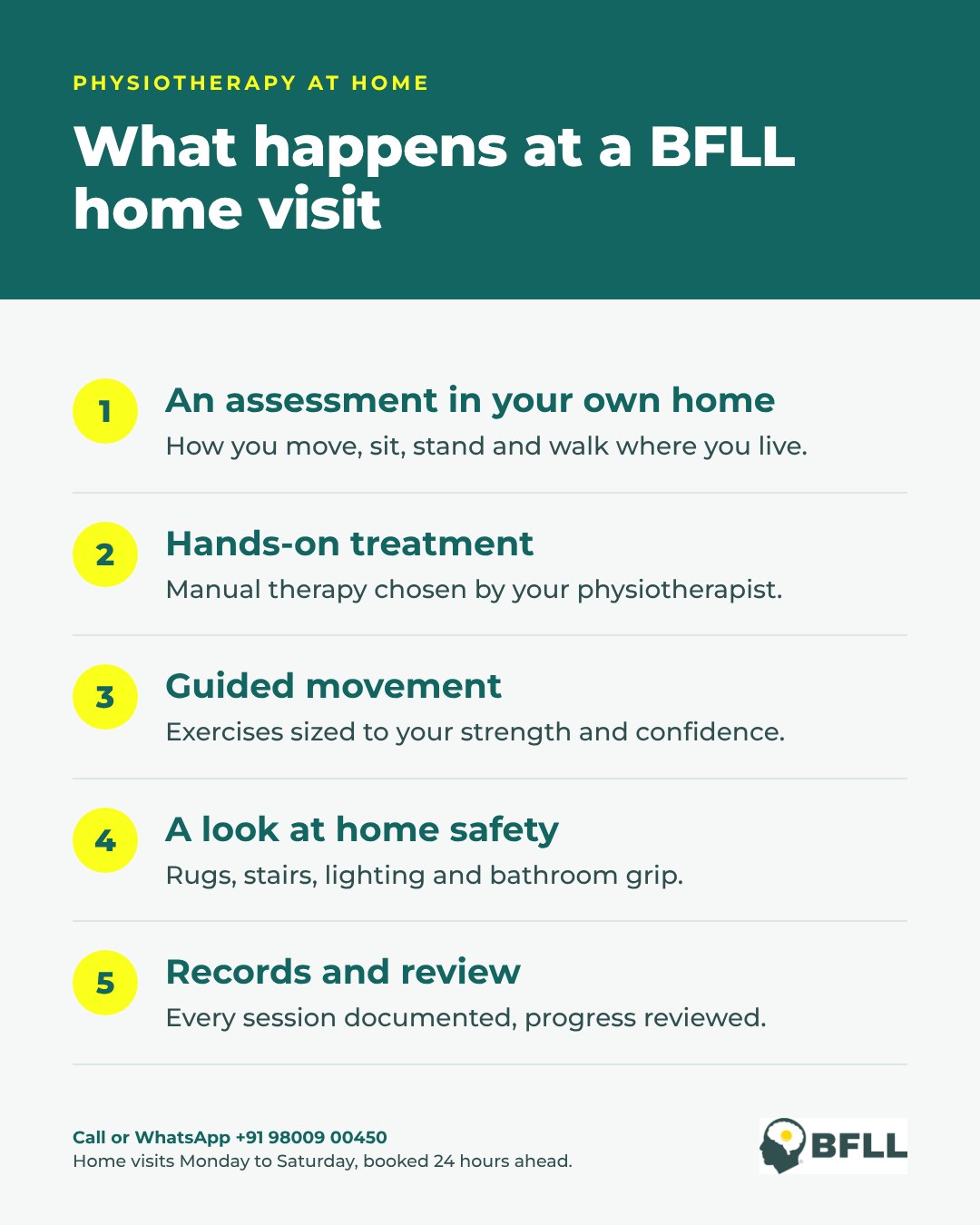
What happens at a home visit
A good home session is more than a massage and a few stretches. At BFLL, a home visit follows the same documented, assessment-first approach as a clinic session.
1. An assessment in your own home
At the first visit the physiotherapist records a baseline: pain, joint movement, muscle strength, balance, how the person gets in and out of bed and a chair, and how they walk across the rooms they actually use. Previous prescriptions and reports are read before anything starts. Each case is graded by how complex it is, and the visits are given to a physiotherapist cleared for that level of case, who stays with the patient for the course.
2. Hands-on treatment
Each session lasts about an hour. It can include manual therapy such as myofascial release and cupping where indicated, and one portable electrotherapy machine, ultrasound (UST) or TENS, when the physiotherapist judges it suitable.
3. Guided movement
Exercises are chosen for the person’s current level: standing up from a firm chair, supported standing balance, gentle range-of-motion work and short walks inside the home. Family members are shown how to help safely, without lifting in a way that strains their own backs. If you are the one doing most of the caring, our article on caregiver burnout is worth a read.
4. A look at home safety
Physiotherapists notice what families often miss: a loose rug, a dark passage to the bathroom at night, a bed or chair that is too low, nothing to hold beside the toilet. Simple changes like these are discussed alongside the exercises.
5. Records and review
Every session is documented, so progress can be compared over time and shared with your treating doctor.
What cannot be done at home
Some treatments need equipment that does not travel. Interferential therapy (IFT), laser therapy (photobiomodulation) and supervised strength training are done at our Naktala or Salt Lake clinic. When a person is ready to travel, many families move on to clinic care: OPD physiotherapy for pain relief and recovery, Pain Lab programmes for the knee, back and shoulder, and Therapeutic Strength Training for building strength under supervision.
When to see a doctor first
Home physiotherapy is not emergency care. Please contact a doctor or go to a hospital first if there is:
- Chest pain, breathlessness at rest, or fainting.
- Sudden weakness or numbness on one side, slurred speech or a drooping face. These can be signs of a stroke and need emergency care.
- A fall followed by being unable to stand or bear weight, or a limb that looks newly deformed.
- A hot, red, swollen joint with fever.
- Back pain with new loss of bladder or bowel control, or numbness around the groin.
Please keep all medicines, including painkillers, blood thinners, and diabetes and blood pressure medicines, exactly as your treating doctor has prescribed. Your physiotherapist will not change them.
How home physiotherapy works at BFLL
Home visits are served from both our branches, Monday to Saturday. There are no home visits on Sunday.
- Share the details. Send the patient’s area and PIN code, the main problem and any prescriptions or reports on WhatsApp to +91 98009 00450.
- Book at least 24 hours ahead. Same-day home sessions are not possible. Payment confirms the booking.
- Standard prices. A one-time First-time Home Assessment of Rs 500 is charged at the first home visit, and a single home session is Rs 1,200. Travel within 10 km of a branch is included. Packs and full details are on our home physiotherapy page.
- New patient offer. Till 31 January 2027, people who have never registered or taken any session with BFLL can take 4 home sessions for Rs 1,000 in all (the first session is free), within 10 km of a branch, with no separate assessment fee. The full terms are on our offers page.
Frequently asked questions
How long is each home session?
About one hour, including assessment checks, hands-on treatment and guided exercises.
Can strength training be done at home?
Gentle, guided exercises are part of every home session. Supervised strength training with equipment is done at the clinic through Therapeutic Strength Training, once the person can travel.
Do we need a doctor’s referral?
A referral is not needed to book, but please share recent prescriptions and reports. After recent surgery, or with a heart or neurological condition, our team will first speak with you to plan the safest next step, and your treating doctor’s advice comes first.
How many sessions will be needed?
That depends on the assessment and on how the person responds, so we do not promise a number in advance. Progress is reviewed at each visit and discussed with you.
Are home visits available on Sunday?
No. Home physiotherapy runs Monday to Saturday, booked at least 24 hours ahead.
Care at BFLL Wellness, Kolkata. Call or WhatsApp +91 98009 00450, or book an appointment at https://bfllwellness.com/book-an-appointment/.
BFLL Naktala (head branch): 1/183, Ground Floor, Naktala, near Naktala Udayan Sangha Club, Kolkata 700047.
BFLL Salt Lake: AD-222, Sector-I, Salt Lake, Kolkata 700064.
Medical disclaimer: This article is for education only and is not a substitute for personalised medical advice. Always consult a qualified healthcare professional before changing your exercise, treatment or medicines.
Compiled and written by Soumick Mondal Raj, Founder and CEO of BFLL, Holistic Health Consultant.
Sources
- World Health Organization. Rehabilitation: fact sheet. 22 April 2024. Link
- Kortebein P, Ferrando A, Lombeida J, Wolfe R, Evans WJ. Effect of 10 days of bed rest on skeletal muscle in healthy older adults. JAMA. 2007;297(16):1772-1774. Link
- Buhagiar MA, Naylor JM, Harris IA, et al. Assessment of outcomes of inpatient or clinic-based vs home-based rehabilitation after total knee arthroplasty: a systematic review and meta-analysis. JAMA Netw Open. 2019;2(4):e192810. Link
- Sherrington C, Fairhall NJ, Wallbank GK, et al. Exercise for preventing falls in older people living in the community. Cochrane Database Syst Rev. 2019;1:CD012424. Link
- Montero-Odasso M, van der Velde N, Martin FC, et al. World guidelines for falls prevention and management for older adults: a global initiative. Age Ageing. 2022;51(9):afac205. Link
- UNFPA India. India Ageing Report 2023: elderly to make up over 20% of the population by 2050. 27 September 2023. Link