
Many women in Kolkata first hear the words PCOD or PCOS in a gynaecologist’s chamber, after months of irregular periods, stubborn acne, thinning hair or weight that settles around the waist and will not move. Often the conversation ends with an ultrasound report and a prescription. What is discussed far less is that this condition reaches well beyond the ovaries, into blood sugar, cholesterol, the liver and mood.
That is why, in May 2026, an international consortium led from Monash University published a consensus in The Lancet giving the condition a new name: polyendocrine metabolic ovarian syndrome, or PMOS. The change is being phased in over about three years. The diagnostic criteria have not changed. The new name simply says what researchers have long known: this is a whole-body hormonal and metabolic condition. In this article we use PCOS, the name most readers still search for.
How common is PCOS in India?
More common than most families realise. The Indian Council of Medical Research commissioned a national study of 9,824 women aged 18 to 40 across India, published in JAMA Network Open in 2024. Using the widely used Rotterdam criteria, 19.6 percent of the women met the definition of PCOS; using the stricter NIH criteria, 7.2 percent did. The same study found high rates of metabolic risk factors such as abnormal cholesterol and a raised risk of fatty liver. Worldwide, the consensus group estimates that about one in eight women has the condition, and many are never diagnosed.
How PCOS is diagnosed, and what the scan does not tell you
The 2023 International Evidence-based Guideline, endorsed by dozens of medical societies, uses the Rotterdam approach. An adult is diagnosed when two of these three are present, after other causes such as thyroid or prolactin problems have been ruled out:
- Irregular or absent ovulation. Usually seen as cycles that are infrequent, unpredictable or very long.
- Signs of high androgens. Excess facial or body hair, persistent acne or scalp hair thinning, or raised testosterone on a blood test.
- Polycystic ovaries. Seen on ultrasound or, in adults, suggested by a raised anti-Mullerian hormone (AMH) level.
Two points are worth knowing. First, the so-called cysts are immature follicles, not true cysts, and a woman can have PCOS without them. Second, in teenagers within eight years of their first period, ultrasound and AMH are not used for diagnosis, because many healthy young ovaries look polycystic. The diagnosis itself is made by your gynaecologist or endocrinologist.
The insulin resistance link
Insulin resistance is recognised as one of the core drivers of PCOS. When muscle and liver cells respond poorly to insulin, the pancreas releases more of it to keep blood sugar in range. High insulin acts on the ovaries, which produce more androgens, and it lowers a carrier protein called SHBG, so more free testosterone circulates. Androgens in turn favour fat storage around the abdomen, which deepens insulin resistance. It becomes a loop.
This is not only a weight story. A systematic review of clamp studies, the most precise way to measure insulin action, found that women with PCOS show insulin resistance beyond what their body weight explains, including lean women. If you are slim and have PCOS, the metabolic side still deserves attention. We explain fasting insulin and HOMA-IR in detail in our article on prediabetes and insulin resistance, so we will not repeat it here.
Over a lifetime, PCOS is linked with a higher risk of type 2 diabetes, unhealthy cholesterol levels, fatty liver and diabetes in pregnancy. Knowing this early is useful, because these risks can be checked with simple tests.
Tests worth discussing with your doctor
The international guideline recommends that every woman with PCOS, whatever her weight, has these checked:
- Blood sugar status at diagnosis. The 75 g oral glucose tolerance test (OGTT) is described as the most accurate; fasting glucose and HbA1c can be used when an OGTT is not possible. Re-checks every one to three years depending on other risk factors.
- A lipid profile. Cholesterol and triglycerides at diagnosis, then as your risk dictates.
- Blood pressure. At least once a year, and before planning a pregnancy.
- Mood. Screening for depression and anxiety, which are more common in PCOS and very treatable.
- Thyroid and other hormones. Thyroid tests help rule out conditions that mimic PCOS. Testosterone and other hormone tests are ordered by your doctor where needed.
A note on fasting insulin. The guideline does not recommend insulin tests for diagnosing PCOS, because insulin assays vary between laboratories. At BFLL we read fasting insulin together with fasting glucose, HbA1c and lipids as a tracking marker over time, never as a diagnosis on its own.
Everyday habits the guideline recommends
Lifestyle care is recommended for every woman with PCOS, at every body size. The guideline is clear that no single diet has been shown to work better than others, so the best plan is one you can keep up. For adults it suggests 150 to 300 minutes a week of moderate activity, or 75 to 150 minutes of vigorous activity, plus muscle-strengthening exercise on two non-consecutive days a week, and less time sitting. It also asks health professionals to avoid weight stigma and to ask permission before weighing.
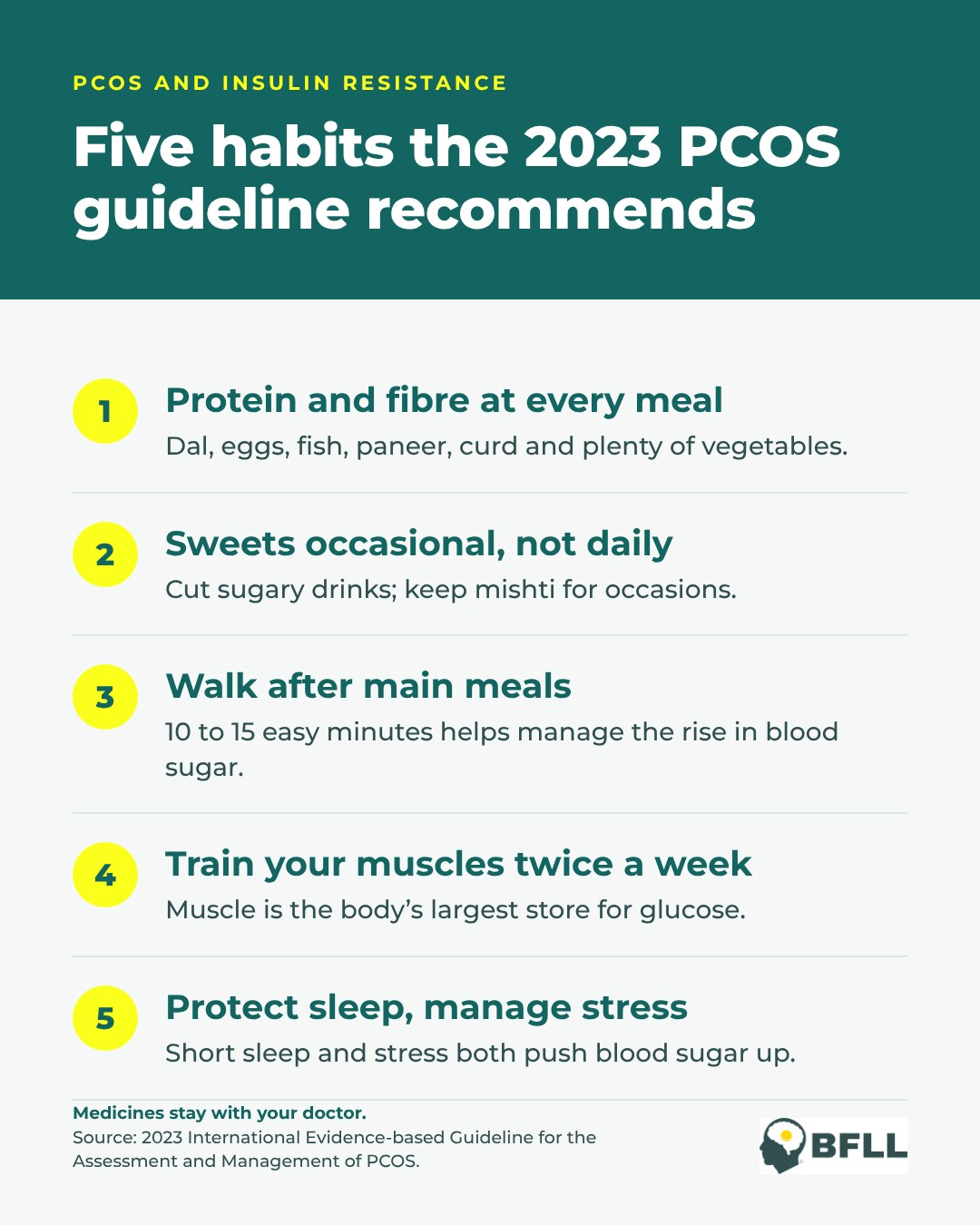
- Build meals around protein and fibre. Dal, eggs, fish, paneer, curd and plenty of vegetables, with whole grains in place of maida.
- Cut sugary drinks and frequent sweets. Mishti is part of life in Kolkata; keep it occasional rather than daily.
- Walk for 10 to 15 minutes after main meals. An easy habit that helps manage the rise in blood sugar after eating.
- Train your muscles twice a week. Muscle is the body’s largest store for glucose. Supervised Therapeutic Strength Training is one way to do this safely.
- Protect sleep and manage stress. Short sleep and chronic stress both push blood sugar up; see our article on stress, cortisol and blood sugar.
Avoid crash diets and very low calorie plans unless your doctor supervises them. They are hard to sustain and can feed an unhealthy relationship with food.
How BFLL works with PCOS
At BFLL, PCOS is handled within MHM, Metabolic Health Management, our three-month nutrition therapy course for metabolic conditions. We do not give a personalised nutrition plan without blood reports, because the plan is built on your data.
1. Blood panel first
The 12-parameter comprehensive panel covers fasting insulin, fasting glucose, HbA1c, lipid profile, thyroid profile (FT3, FT4, TSH), liver and kidney function, vitamin D, vitamin B12, complete hemogram, CRP and hs-CRP. It is Rs 3,980 at the clinic, and Rs 3,400 on the current offer until 31 January 2027. Home sample collection is available in serviceable PIN codes. See blood tests at BFLL and our current offers. Hormone tests are added only where they are indicated.
2. Health profile and assessment
You fill in an online health profile and share your reports. A Rs 2,000 advance starts the process and is part of the plan price, not an extra. Our Holistic Health Consultant and nutrition team review your reports, history and lifestyle before the plan is confirmed.
3. A personal nutrition plan
The plan uses our EGL (Effective Glycaemic Load) and NOCC (Nutrient Over Calorie Concept) principles, with Bengali home food at its centre. MHM is a fixed three-month course in monthly cycles; the OPD price is Rs 8,640 for three months. Support continues through our nutrition WhatsApp group and meal photo reviews.
4. Movement, where suitable
If strength training is appropriate, it is done under supervision after the Holistic Health Consultation, which is required before Therapeutic Strength Training.
5. Re-test and review
Reports are repeated at sensible intervals so that you and your doctor can see what has changed, and the plan is adjusted to the new numbers.
We work alongside your gynaecologist or endocrinologist, not in place of them. Please keep all medicines, including metformin or hormonal pills, under your treating doctor, and never stop or change a medicine on your own.
Frequently asked questions
Are PCOD and PCOS the same thing?
In India the two terms are used for the same condition. PCOS is the medical name, and the new international name is PMOS, polyendocrine metabolic ovarian syndrome.
I am thin. Can I still have insulin resistance?
Yes. Research shows insulin resistance in women with PCOS beyond what body weight explains, including lean women. Blood sugar and lipid checks are recommended for every woman with PCOS, whatever her weight.
Will losing weight make PCOS go away?
PCOS is a long-term condition, and no one can promise a particular result or timeline. Guidelines place healthy eating and activity at the base of care at every body size. At BFLL we track your reports, waist and strength over time rather than the scale alone.
Should I stop my metformin or contraceptive pill if I start a nutrition plan?
No. Medicine decisions belong to your treating doctor. We share your reports and progress so that your doctor has the full picture.
Can I give the blood sample at home?
If your PIN code is serviceable, yes. Share your PIN code on WhatsApp and the team will confirm. If not, a sample can be given at our Naktala or Salt Lake clinic.
Care at BFLL Wellness, Kolkata. Call or WhatsApp +91 98009 00450, or book an appointment at https://bfllwellness.com/book-an-appointment/.
BFLL Naktala (head branch): 1/183, Ground Floor, Naktala, near Naktala Udayan Sangha Club, Kolkata 700047.
BFLL Salt Lake: AD-222, Sector-I, Salt Lake, Kolkata 700064.
Medical disclaimer: This article is for education only and is not a substitute for personalised medical advice. Always consult a qualified healthcare professional before changing your diet, exercise or medicines.
Compiled and written by Soumick Mondal Raj, Founder and CEO of BFLL, Holistic Health Consultant.
Sources
- Teede HJ, Tay CT, Laven JJE, et al. Recommendations from the 2023 International Evidence-based Guideline for the Assessment and Management of Polycystic Ovary Syndrome. Published together in Human Reproduction, J Clin Endocrinol Metab, Fertility and Sterility and Eur J Endocrinol, 2023. Link
- Monash University / Monash IVF. Summary: International evidence-based guideline for the assessment and management of polycystic ovary syndrome 2023. Link
- Teede HJ, et al. Global consensus on renaming polycystic ovary syndrome to polyendocrine metabolic ovarian syndrome (PMOS). The Lancet, May 2026. doi:10.1016/S0140-6736(26)00717-8. Link
- Healio Endocrinology. From PCOS to PMOS: what the name change may mean for clinical practice. 13 August 2026. Link
- Ganie MA, et al. Prevalence, Phenotypes, and Comorbidities of Polycystic Ovary Syndrome Among Indian Women (ICMR-PCOS study). JAMA Network Open, 2024. Link
- Cassar S, Misso ML, Hopkins WG, et al. Insulin resistance in polycystic ovary syndrome: a systematic review and meta-analysis of euglycaemic-hyperinsulinaemic clamp studies. Hum Reprod. 2016;31(11):2619-2631. Link
- NHS. Polycystic ovary syndrome. Link